

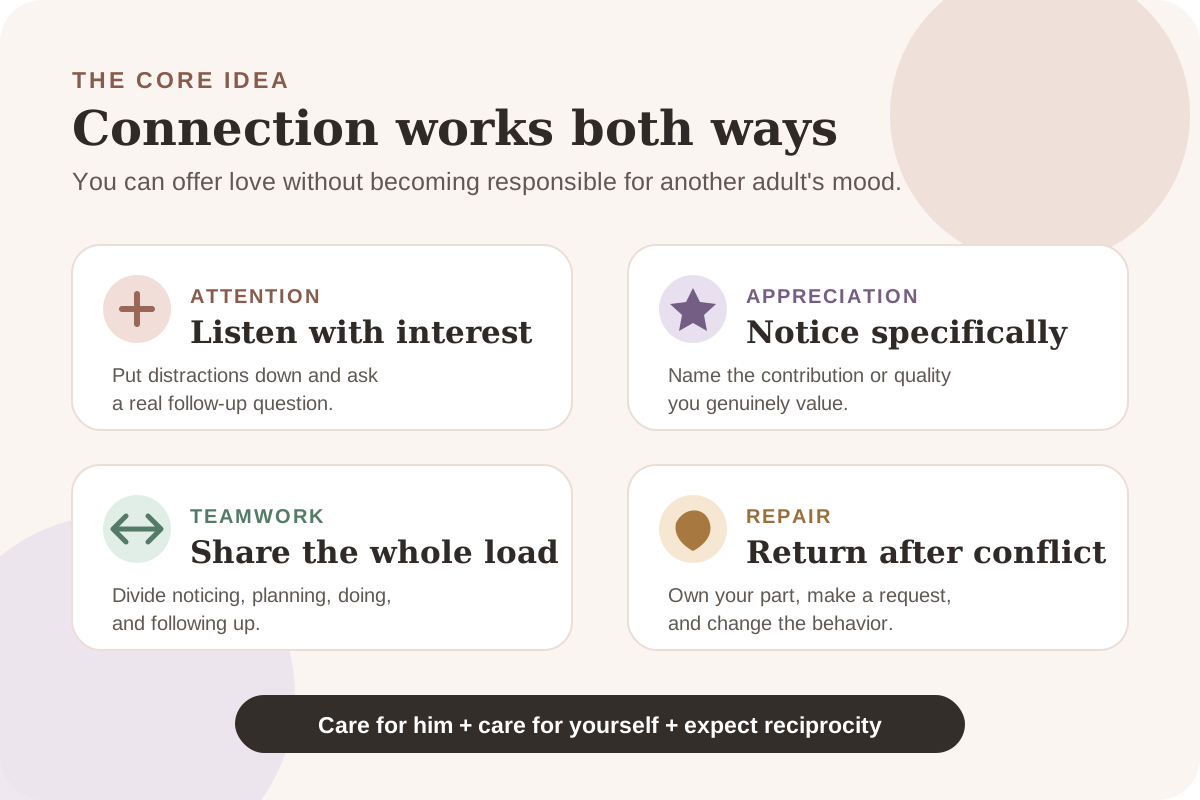
Wanting your husband to feel happy and loved is generous. But his happiness is not a performance review you must pass. A strong marriage is built by two adults who learn each other's needs, share responsibility, repair mistakes, and protect room for both people to remain whole.
How Can You Make Your Husband Happy?
Start with curiosity instead of assumptions. Ask what helps him feel loved, listen without immediately defending yourself, and tell him what helps you feel close too. Then turn those answers into small habits: specific appreciation, undistracted attention, fair teamwork, welcome affection, shared fun, and respectful conflict repair.
 Support Non-AI Creator
What Does a Happy Husband Actually Need?
People differ more than stereotypes suggest. One husband may value affectionate touch; another may feel closest during conversation, humor, shared projects, quiet companionship, sex, practical support, or time to decompress. The same person may need different things during a stressful week than during an ordinary one.
Relationship researchers often use the idea of perceived partner responsiveness: feeling that a partner understands, validates, and cares for you. Studies link this sense of responsiveness with intimacy and relationship well-being. That does not require agreeing with every opinion. It means your partner experiences you as interested in his inner world rather than merely managing his behavior.
Use a Better Question
Try: “When have you felt most supported by me lately?” Then answer the same question for yourself. This produces more useful information than asking a vague “Are you happy?”
10 Practical Ways to Make Your Husband Feel Loved
1. Give Him Undistracted Attention
Put the phone down for a short, defined window and follow what he is saying. Ask one real follow-up question. Five attentive minutes can create more connection than an hour spent in the same room while both people are half elsewhere.
This matters when he shares good news too. Research on responding to a partner's positive events suggests that active, enthusiastic responses are associated with healthier relationship outcomes. Instead of “That's nice,” try “You worked hard for that. What part are you happiest about?”
2. Appreciate Something Specific
General praise can become background noise. Specific appreciation tells him what you genuinely noticed: “Thank you for handling that call when I was overwhelmed,” or “I love how patient you were with the kids tonight.”
Research on expressed gratitude suggests benefits can extend to both partners, particularly when appreciation is perceived as sincere and responsive. Appreciation should not be used to manipulate him into doing more; it should name a contribution or quality you truly value.
3. Learn What Support Means to Him
When he brings up a problem, ask, “Do you want ideas, practical help, or someone to listen?” Some people feel dismissed when advice arrives too quickly. Others feel stranded when a partner listens but never helps. Asking removes the guesswork.
Do not confuse support with taking over. Encourage his competence and choices while remaining available. Healthy support says, “I am with you,” not, “You cannot handle this without me.”
4. Share the Visible and Invisible Work Fairly
Cooking dinner once does not necessarily balance one partner remembering appointments, tracking supplies, planning meals, organizing family communication, and noticing what must happen next. Relationship research on household labor repeatedly finds that perceived fairness matters.
Make the work visible. List recurring responsibilities, decide who owns each one from noticing through completion, and revisit the arrangement when jobs, health, or parenting demands change. Fair does not always mean identical; it means both people understand and accept the division. Research on perceived fairness in housework and shared expenses reinforces why the agreement matters as much as a simple task count.
 Support Non-AI Creator
5. Protect Affection That Both of You Welcome
A warm greeting, hand on the shoulder, long hug, kiss, cuddle, or sexual connection can reinforce closeness when it is wanted. Studies associate affectionate touch with relationship satisfaction and reduced stress, but touch is not a quota and consent still matters inside marriage.
Ask what kind of affection feels good during ordinary days and stressful days. If desire levels differ, treat the difference as a shared conversation rather than proof that one person is defective or withholding.
6. Celebrate His Good News
Do not save emotional energy only for problems. Mark his wins, even small ones. Let your face and voice show that his joy matters to you. Celebration can be as simple as a favorite snack, a proud message, or giving him ten minutes to tell the whole story.
This is not flattery. You can be genuinely happy for him while still maintaining your own ambitions, friendships, and identity.
7. Repair After Conflict
Happy couples still annoy and disappoint each other. The difference is often what happens next. Slow the conversation when either person is flooded, return at an agreed time, own your part without adding “but,” and address the specific problem instead of attacking character.
Useful repair language includes: “That came out harsher than I intended,” “I understand why that hurt,” “My part was…,” and “What would help us handle this differently next time?” Repair does not mean pretending a recurring issue is solved before behavior changes.
 Support Non-AI Creator
8. Keep Friendship and Fun Alive
Marriage can become an operations meeting about bills, children, chores, and schedules. Protect some interaction with no problem-solving agenda: a walk, shared show, card game, cooking experiment, playlist, coffee outside, or private joke.
Choose activities both of you can enjoy rather than repeatedly proving love by joining only his interests. Curiosity can be mutual: take turns choosing low-pressure plans.
9. Respect His Autonomy and Protect Your Own
Time with friends, solitary hobbies, exercise, rest, and personal goals are not automatic threats to marriage. Healthy closeness includes room to be separate. Support reasonable independence while making agreements about time, money, parenting, and communication.
The same freedom belongs to you. Making your husband happy should not require abandoning the self-care and relationships that sustain your own well-being.
10. Create Small Rituals of Connection
Rituals reduce the need to wait for inspiration. Try a six-second kiss when one of you leaves, tea together after dinner, a Friday walk, a Sunday planning check-in, or one “high and low” from the day before bed.
Keep the ritual realistic. A ten-minute habit that survives busy weeks is more valuable than an elaborate date plan that becomes another source of pressure.
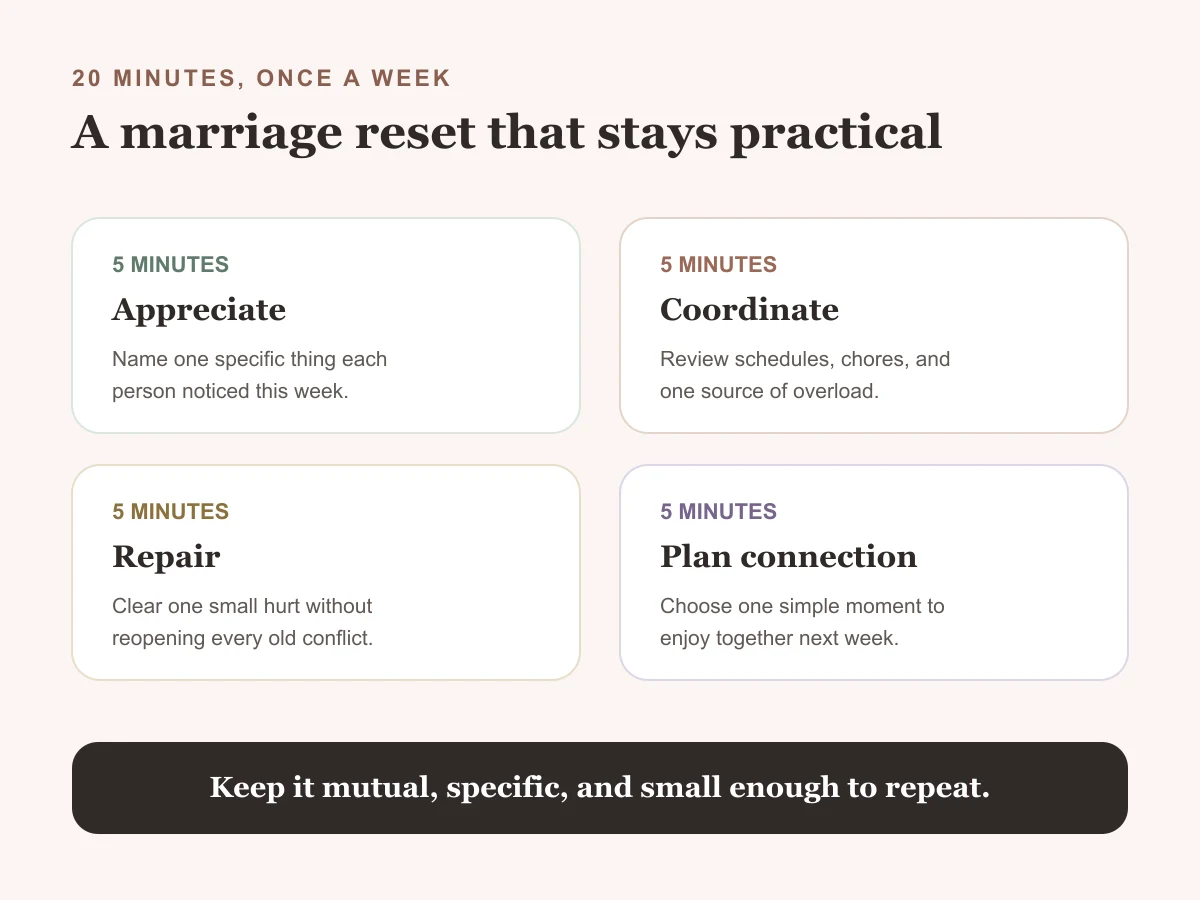
Try This 20-Minute Weekly Marriage Reset
Set a timer and give each person equal space:
- Appreciation: Name one thing your partner did that helped.
- Stress: Share one pressure you are carrying outside the relationship.
- Logistics: Identify the most demanding task in the coming week and divide support clearly.
- Connection: Choose one small thing to look forward to together.
- Repair: Raise one manageable irritation using a specific request rather than a global accusation.
This check-in is not suitable for resolving severe conflict while either person feels unsafe. It is a maintenance habit for couples who can speak without threats, intimidation, or retaliation.
 Support Non-AI Creator
What Does Not Create Lasting Happiness?
- Mind-reading: Guessing what he needs and feeling resentful when the guess is wrong.
- Keeping score secretly: Doing favors as unspoken contracts instead of discussing fairness.
- Avoiding every disagreement: Short-term peace can hide long-term loneliness and unresolved problems.
- Using sex, food, praise, or silence as control: Connection should not be a reward-and-punishment system.
- Shrinking yourself: Dropping boundaries, goals, opinions, friendships, or financial independence to prevent his displeasure.
- Accepting disrespect: Contempt, monitoring, coercion, threats, and violence are not signs that you need better relationship tips.
His Mood Is Not Entirely Yours to Manage
Depression, anxiety, grief, burnout, addiction, work stress, physical illness, and unresolved trauma may affect happiness. Loving support can matter, but it cannot replace his own participation or appropriate professional care.
When More Support Is Needed
Consider a qualified couples therapist when the same conflict repeats without resolution, communication routinely collapses, trust has been damaged, intimacy feels impossible to discuss, or both partners want help learning new skills. Individual support may be more appropriate when one person is not willing to participate honestly.
Couples counseling is not the first step when there is fear, coercive control, stalking, threats, or physical or sexual violence. The CDC's intimate partner violence information explains that healthy relationships require safety and respect. Seek confidential safety support rather than trying harder to please an abusive partner.
For everyday relationship maintenance, research supports themes such as expressed gratitude, partner responsiveness and affectionate touch, and communication and conflict-management skills. Use those findings as direction, not as a formula that guarantees another person's mood.
Frequently Asked Questions
What makes a husband feel loved the most?
There is no universal answer. Many people feel loved through attentive listening, specific appreciation, dependable support, affection, shared fun, or practical help. Ask your husband which moments make him feel closest to you instead of relying on gender stereotypes or guessing.
How can I make my husband happy every day?
Aim for small, repeatable moments rather than managing his mood. Greet him warmly, give one specific appreciation, offer a few minutes of undistracted attention, share responsibilities fairly, and ask what support would be useful. He remains responsible for communicating and caring for his own well-being too.
How do I make my husband feel special without spending money?
Remember something he mentioned, send a thoughtful message, make time for an activity he enjoys, celebrate good news enthusiastically, offer affection he welcomes, or take one agreed task off his plate. Personal attention usually feels more specific than an expensive generic gift.
What if I am trying hard but my husband is still unhappy?
One partner cannot create a healthy marriage alone. Ask directly what feels missing and explain your own needs too. Persistent contempt, fear, control, threats, or emotional or physical harm are not problems to solve by becoming more pleasing; prioritize safety and qualified support.
The Bottom Line
Make your husband feel loved by knowing him, not by serving a stereotype. Offer attention, appreciation, support, affection, fairness, fun, and honest repair while expecting the same care in return. A happy marriage is not one person working endlessly to stabilize the other; it is a relationship both people actively make safer, warmer, and more generous.