
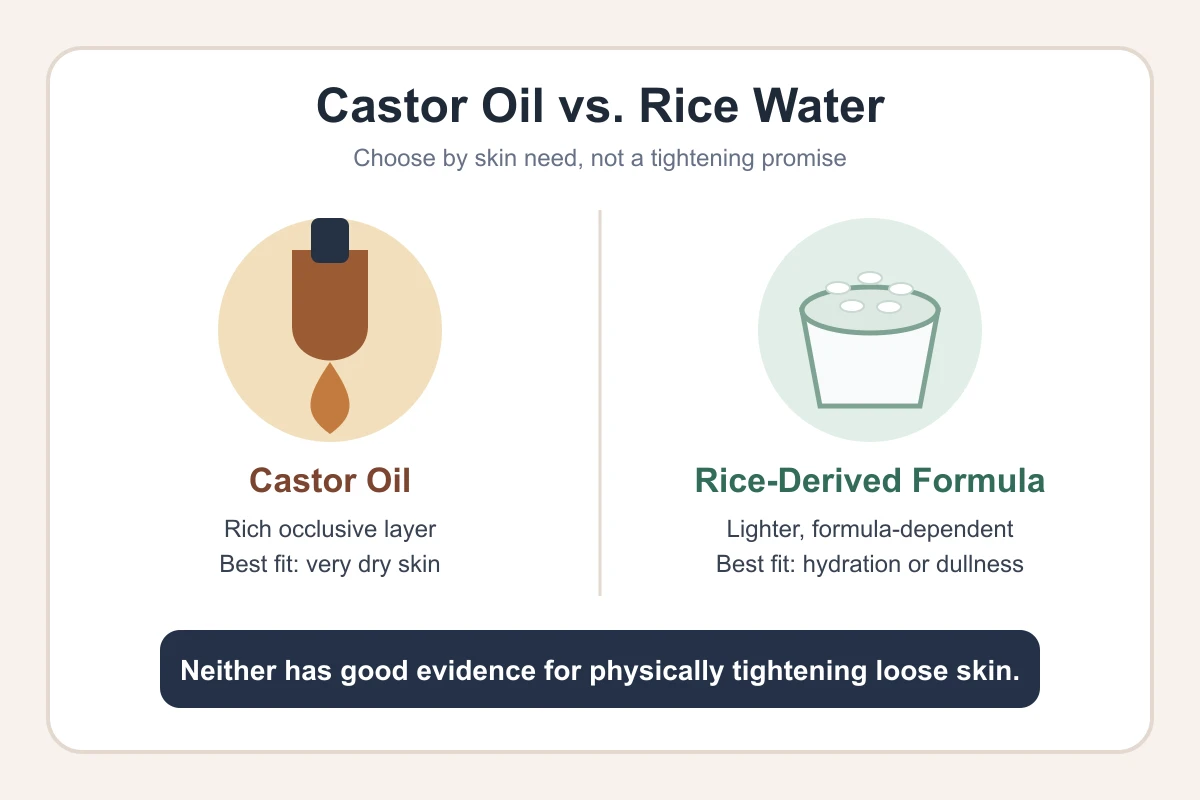
Castor oil and rice water are often compared as natural ways to tighten skin, fade dullness, or create a smoother face. The problem is that those claims combine several different outcomes. Softer dry skin, a temporary dewy finish, and true tightening of loose tissue are not the same result.
The better choice depends on what your skin actually needs. Castor oil is a dense plant oil that can reduce moisture loss. Rice water is a broad label that may mean homemade starchy water, a fermented filtrate, or a preserved cosmetic extract. Those products do not have the same composition, stability, or evidence.
Castor Oil or Rice Water: Which Is Better?
Choose castor oil only when the main problem is very dry, rough skin and you tolerate a heavy oil. Choose a preserved rice-derived toner or essence when you want a lighter layer for hydration or dull-looking skin. Choose neither if your primary goal is lifting sagging skin, because neither option has convincing evidence for structural tightening.
Surface Smoothing Is Not Skin Tightening
An oil can make dry creases look softer, and a watery toner can make skin look fresher. Those are useful cosmetic effects, but they do not show that collagen has been rebuilt or loose tissue has contracted.
Castor Oil vs. Rice Water at a Glance
| Question | Castor Oil | Rice Water or Rice Extract |
|---|---|---|
| Best fit | Very dry, rough-feeling areas | Light hydration or dull-looking skin |
| Main action | Forms a rich emollient and occlusive film | Depends on the rice ingredient and complete formula |
| Skin-tightening evidence | Not established | Not established |
| Texture | Thick, sticky, slow to spread | Usually watery or milky |
| Main caution | Irritation, heaviness, or breakouts | DIY spoilage and inconsistent concentration |
What Castor Oil Can Realistically Do for Skin
Castor oil is composed largely of ricinoleic-acid-containing triglycerides. On skin, its most defensible role is simple: it leaves an oily film that can reduce water loss and soften a rough surface. This can help dry areas feel more flexible and can make tiny dehydration lines reflect light more evenly.
That effect does not demonstrate collagen production or tissue contraction. A broad review of topical plant oils and the skin barrier explains that plant oils differ considerably in fatty-acid profile and barrier effects. Castor oil is not supported as a proven facial firming treatment.
Its texture is another practical limitation. Straight castor oil is much thicker than many facial oils, so it can feel sticky, pill under products, and be uncomfortable on oily or acne-prone skin. It may also cause irritation or contact allergy in some users. A finished cream containing castor-derived ingredients is not the same experience as coating the face with undiluted oil.
What Rice Water Can Realistically Do for Skin
Rice water is not one standardized ingredient. The cloudy water from rinsed rice contains mostly water and variable amounts of starch and other compounds. Fermented filtrates, rice-bran extracts, hydrolyzed rice protein, and rice-derived ceramides are processed cosmetic ingredients with very different concentrations and functions.
A review of rice-derived products in dermatology found potential across moisturizing, antioxidant, photoprotective, and other skin applications. That is useful background for formulated rice ingredients, but it should not be converted into a claim that plain soaking water lifts the face.
A preserved rice toner may leave skin feeling lightly hydrated or less greasy than an oil. Any brightening or soothing result also depends on the rest of the formula, which may include glycerin, niacinamide, ferments, or barrier-supporting ingredients. When a commercial toner works well, rice may be only one part of why.
Homemade rice water is harder to recommend for facial use. It has no standardized concentration, pH, preservation system, or validated storage time. A mixture that changes smell, color, or texture should be discarded, and fermenting a kitchen batch does not automatically make it more effective.
 Support Non-AI Creator
Which One Should You Choose for Your Skin?
If Your Skin Is Very Dry
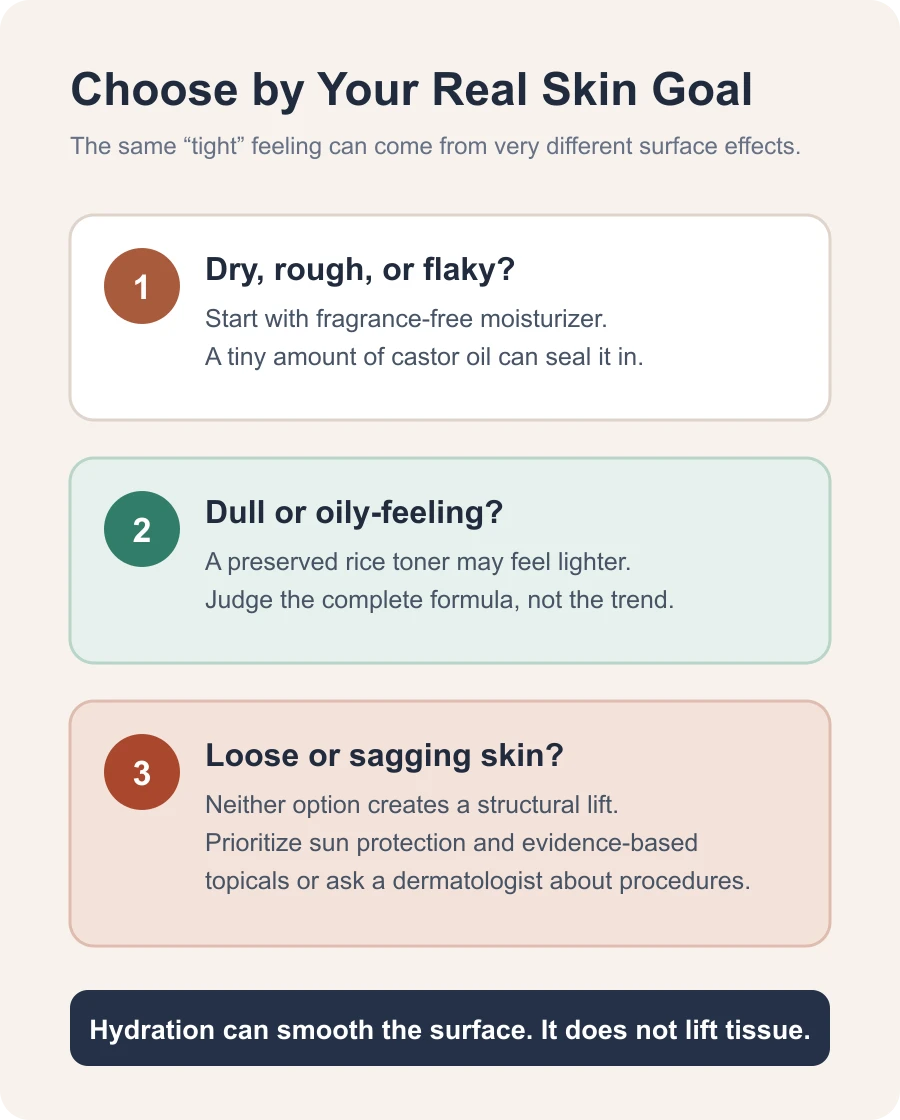
A bland fragrance-free moisturizer is the most predictable first choice. If you already tolerate oils, a tiny amount of castor oil over moisturizer may reduce moisture loss on a rough patch. It is usually too heavy to be the only moisturizer for the whole face.
If Your Skin Is Oily, Combination, or Easily Congested
A lightweight, preserved rice toner may feel more comfortable, but it is optional. Look at the complete ingredient list and avoid assuming that "natural" means non-comedogenic. Stop if new bumps, itching, or persistent redness appear.
If Your Concern Is Dullness or Uneven Tone
A rice-derived formula can be a pleasant supporting step, especially when it also contains proven humectants or tone-support ingredients. Daily broad-spectrum sunscreen matters more for preventing additional uneven pigmentation. Rice water alone should not replace a targeted treatment.
If Your Concern Is Loose or Sagging Skin
Neither option is the right tool. The American Academy of Dermatology explains that firming creams generally produce subtle results and cannot lift sagging skin. Sunscreen, retinoid-based care when appropriate, and clinician-guided procedures have a stronger rationale than either DIY remedy.
For the same reason, be cautious with lists of essential oils for skin tightening. Fragrance, warmth, or temporary surface smoothness can feel active without changing the deeper structure of the skin.
How to Try Either Option More Safely
- Patch-test one product at a time. Use a small area and watch for burning, itching, swelling, or a persistent rash.
- Prefer preserved facial products. A finished rice toner or moisturizer has a defined formula and use instructions.
- Use castor oil sparingly. One or two drops over moisturizer is more practical than a thick facial layer.
- Do not use spoiled DIY mixtures. Odor, gas, separation, or color change are reasons to discard the batch.
- Avoid broken or actively inflamed skin. Get appropriate care for eczema, infection, or a sudden unexplained rash.
- Keep expectations tied to the surface. Hydration and softness are realistic; lifting loose tissue is not.
Frequently Asked Questions
Which is better for skin tightening, castor oil or rice water?
Neither is proven to tighten loose skin. Castor oil can make dry skin look temporarily smoother by reducing moisture loss, while a rice-derived toner may feel lighter and support hydration or tone. Choose by skin type and texture preference, not by an expectation of lifting.
Can castor oil tighten sagging skin?
There is no good clinical evidence that topical castor oil contracts sagging tissue or rebuilds lost collagen. Its thick emollient film can soften dry surface texture, which may make fine creases look less obvious for a short time.
Does rice water make skin firm?
Research on rice-derived cosmetic ingredients is promising for supportive effects such as moisturization and antioxidant activity, but plain homemade rice water has not been shown to firm loose skin. Finished formulas are also more standardized and better preserved than kitchen mixtures.
Can I use castor oil and rice water together?
They can be layered if your skin tolerates both: apply a preserved rice toner first and a small amount of moisturizer or oil afterward. The combination may feel too heavy for acne-prone skin, and adding castor oil does not turn the routine into a tightening treatment.
The Bottom Line
Castor oil is the more occlusive option for very dry skin; a preserved rice-derived formula is the lighter option for hydration or dullness. Neither is a proven skin-tightening treatment. Match the product to a specific surface concern, patch-test it, and use stronger evidence when your real concern is laxity.