
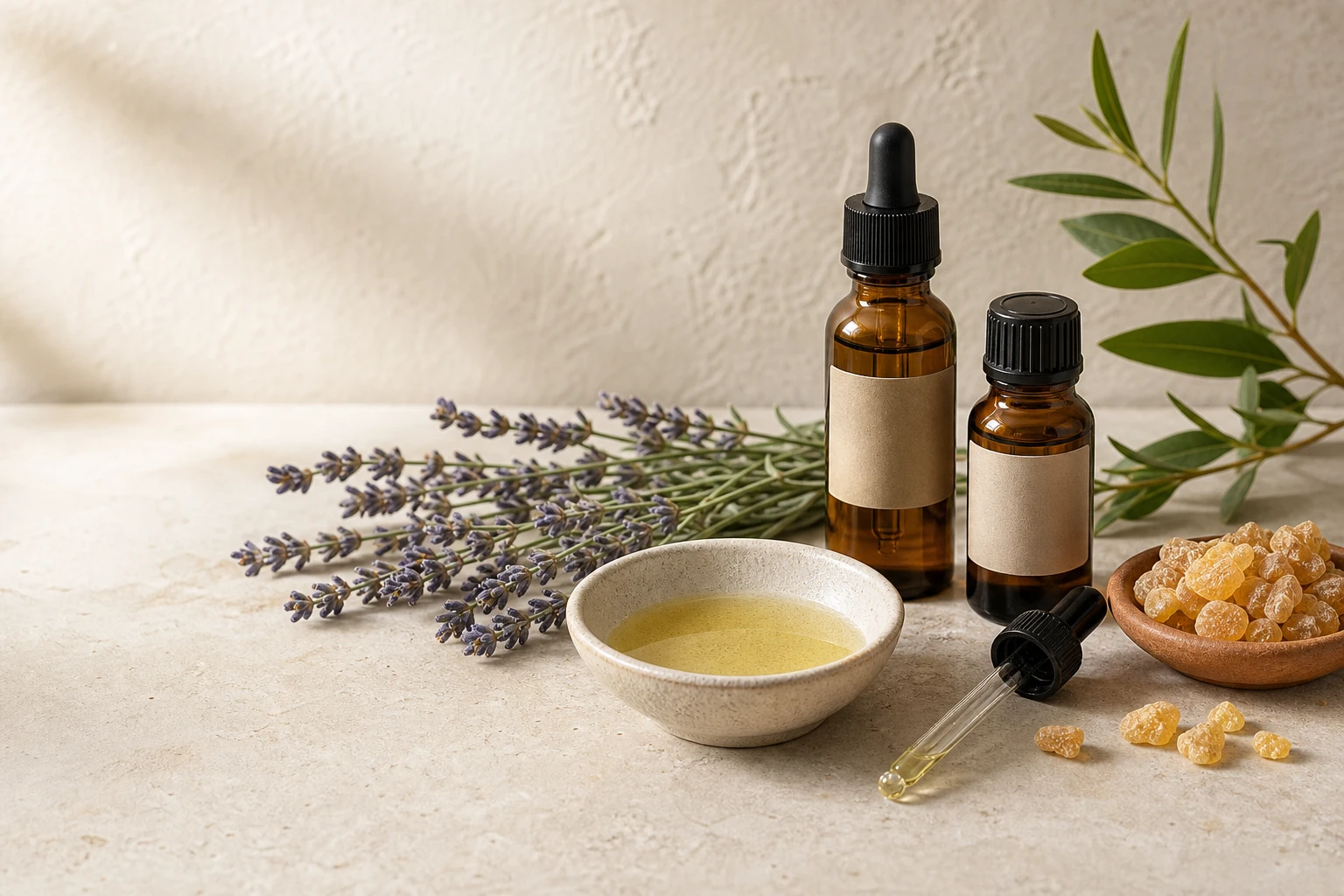
If you search for essential oils to tighten skin, you will quickly find lists promising that frankincense, geranium, lavender, or rose can lift loose areas and rebuild collagen. That claim goes beyond the available evidence. Essential oils are concentrated aromatic extracts; they are not proven skin-lifting treatments.
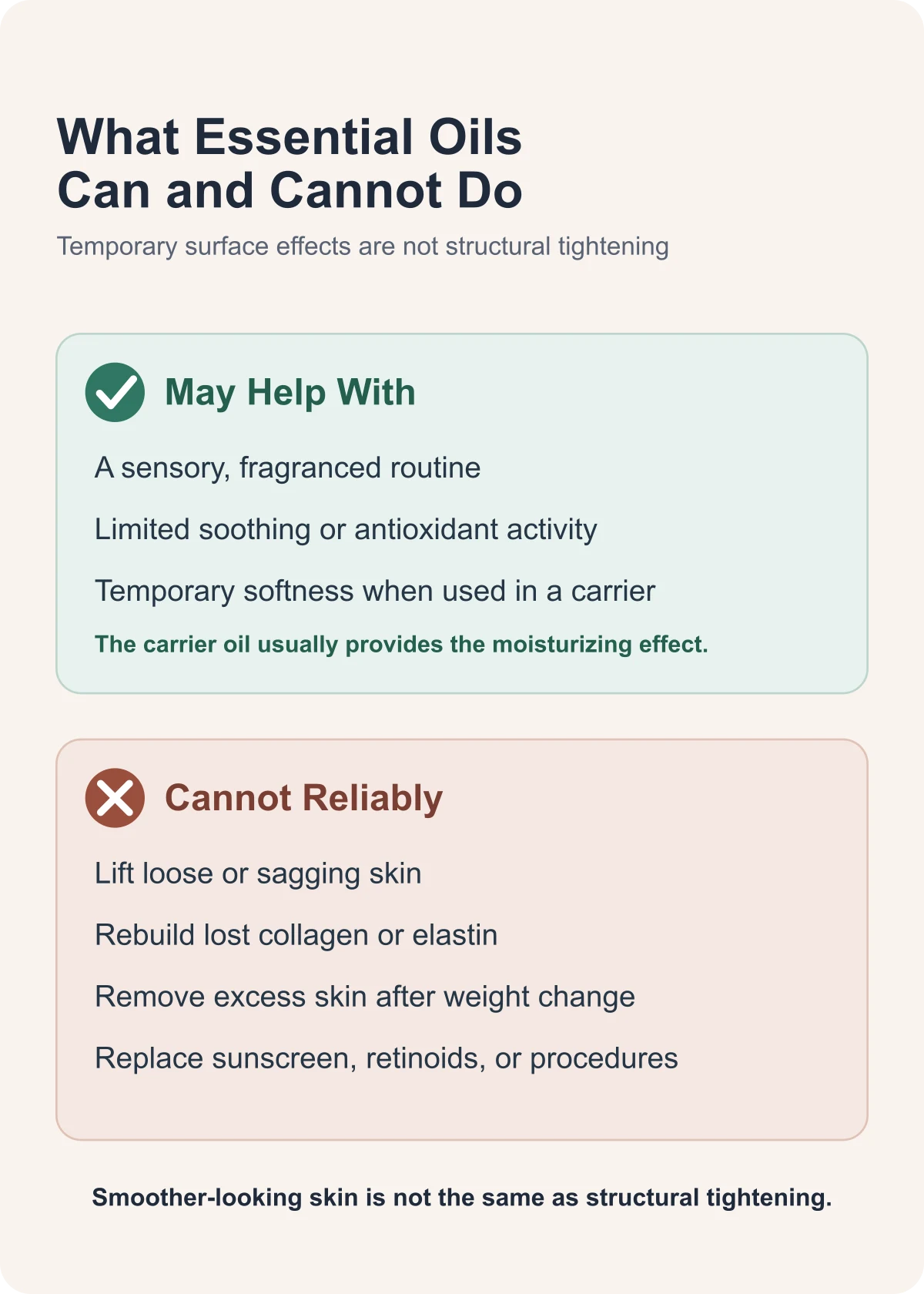
They may still play a limited role in body care. A well-formulated fragranced oil can make dry skin feel softer, and some plant compounds show antioxidant or soothing activity in laboratory research. The useful question is not which oil “tightens” skin, but what result you actually want and whether an essential oil is the safest way to pursue it.
Can Essential Oils Actually Tighten Loose Skin?
No essential oil has convincing human evidence that it lifts sagging skin, shrinks stretched skin, or restores collagen lost through age, sun exposure, pregnancy, or major weight change. Moisturizing the surface can temporarily improve smoothness and make fine creases less noticeable, but it does not contract the deeper dermis.
Tightening Is Not the Same as Moisturizing
Skin can look smoother after oil application because an occlusive layer reduces water loss and improves surface flexibility. That effect is temporary. It should not be described as collagen rebuilding, tissue contraction, or treatment for significant loose skin.
 Support Non-AI Creator
Why Skin May Look or Feel Firmer After Oil
Three short-term effects are often mistaken for tightening:
- Improved surface hydration: Carrier oils and moisturizers reduce transepidermal water loss, helping dry surface cells lie more smoothly.
- Massage-related circulation: Massaging a product into the skin can create temporary warmth, color, or mild puffiness that changes how the area looks.
- A smoother light-reflecting surface: An emollient film fills tiny spaces between dry cells, making texture look more even under light.
These effects can be worthwhile, especially on dry body skin. They simply do not prove that an essential oil has altered elastin, tightened connective tissue, or reversed sagging.
The American Academy of Dermatology notes that firming creams generally produce subtle results at best, and a cream cannot lift sagging skin. Essential oils have even less clinical evidence for that outcome.
What About the Essential Oils Commonly Marketed for Firmness?
The oils below appear frequently in skin-tightening recipes. None has established clinical evidence for lifting loose skin, but their evidence and risks are not identical.
Frankincense
Frankincense is the most common “tightening” recommendation online. One small randomized split-face study reported improvements from a topical cream containing boswellic acids, compounds derived from Boswellia serrata. However, a standardized boswellic-acid cream is not equivalent to frankincense essential oil, and the study does not show that homemade frankincense blends tighten skin.
This distinction matters: extraction method, concentration, delivery system, and the rest of a finished formula determine what reaches the skin. Treating all products from the same plant as interchangeable creates a misleading claim.
Geranium
Geranium essential oil is often described as “astringent.” In skincare language, astringency means a temporary tightening or drying sensation at the surface, not contraction of loose tissue. Laboratory studies describe antimicrobial and antioxidant activity, but there is no persuasive human trial showing that geranium oil firms sagging skin.
Lavender
Lavender is better known for fragrance than firmness. The National Center for Complementary and Integrative Health notes that topical lavender products may cause allergic skin reactions. It should not be added simply because a blend needs a calming scent, especially on reactive facial skin.
Rose and Neroli
Rose and neroli oils contribute fragrance and contain compounds studied for antioxidant activity in laboratory settings. That does not establish a visible tightening effect in people. Fragrance allergy is still possible, and neroli belongs to the citrus family, where oil composition and production method influence sun-sensitivity risk.
Rosemary
Rosemary essential oil contains aromatic compounds with antioxidant and antimicrobial activity in preclinical research. Human evidence for skin firming is lacking. Like other fragranced oils, it may also irritate sensitive or compromised skin.
Cold-Pressed Citrus Oils
Lemon, lime, bergamot, and some other cold-pressed citrus oils can cause phototoxic reactions when treated skin is exposed to ultraviolet light. The risk varies by oil and processing method, but this is enough reason not to include citrus oil casually in a daytime tightening blend. A published review of lime essential-oil phototoxicity illustrates why “natural” does not automatically mean sun-safe.
Essential Oils and Carrier Oils Are Not the Same
Rosehip seed, jojoba, argan, grapeseed, and sweet almond oils are often included in essential-oil lists, but they are carrier oils or fixed plant oils. They contain fatty acids and other nonvolatile compounds and can be used as the moisturizing base into which an essential oil is diluted.
This difference explains why a blend may make skin feel better even when the essential oil contributes little. The carrier oil supplies most of the emollient effect. Rosehip and argan oils have some early research around hydration, barrier support, pigmentation, or elasticity, but that still does not make them reliable treatments for loose skin.
For more on the difference between botanical support and structural claims, see our evidence-aware guide to anti-aging herbs for skin.
How to Use Essential Oils More Safely on Skin
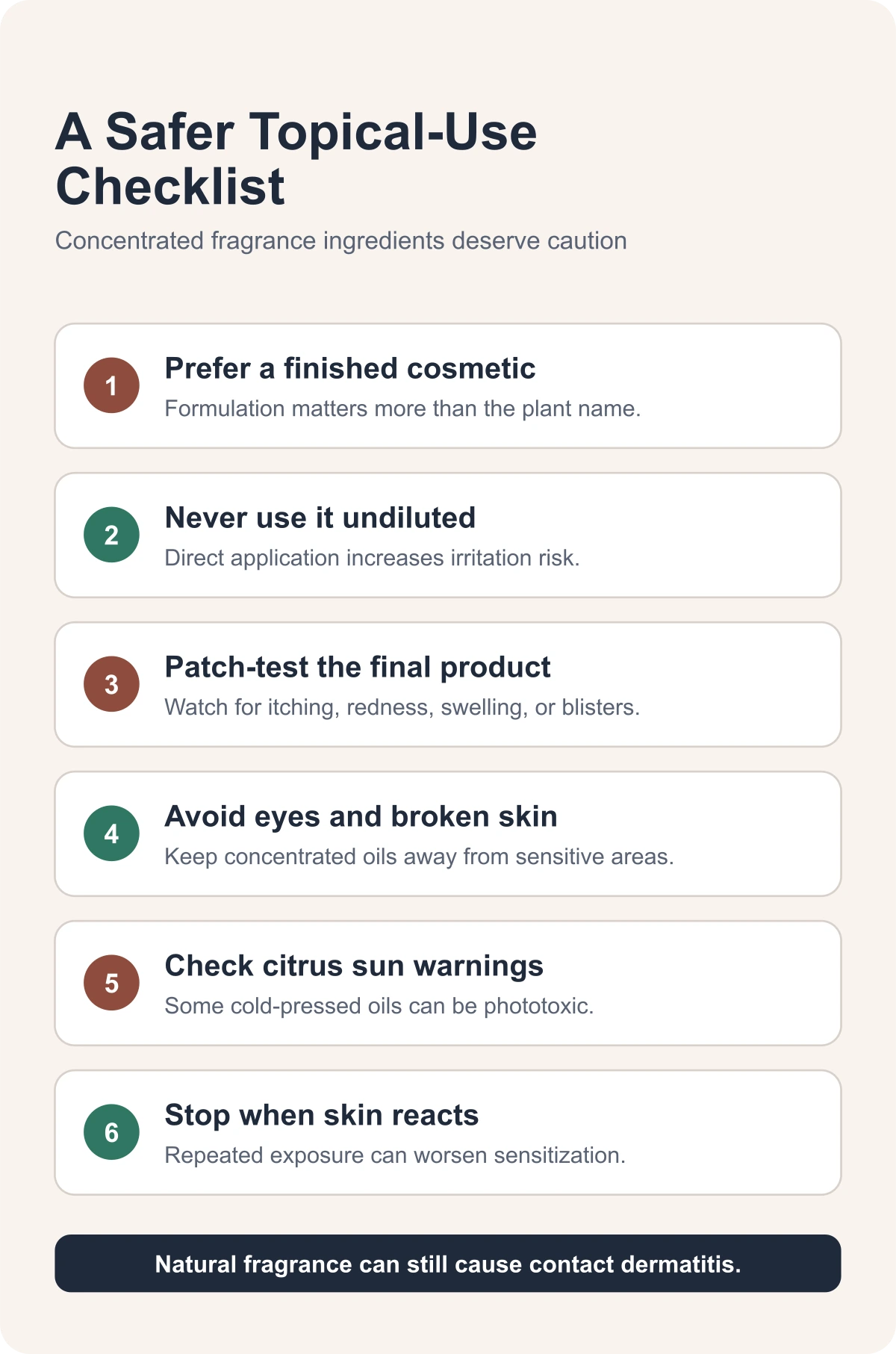
The safest option is usually a finished cosmetic from a reputable manufacturer, where concentration, preservation, stability, and packaging have been considered. Homemade blends make it harder to know the final concentration or whether the combination is appropriate for the face.
 Support Non-AI Creator
- Never apply an undiluted essential oil directly to facial or body skin. Concentration increases the chance of irritation and sensitization.
- Patch-test the finished product. Try a small amount on a limited area and watch for redness, itching, swelling, or blistering.
- Keep oils away from eyes, lips, mucous membranes, and broken skin. Wash thoroughly if accidental exposure occurs.
- Treat citrus oils cautiously. Check the exact botanical name, extraction method, and product sun-exposure instructions.
- Stop if irritation develops. Repeated exposure after a reaction can make sensitivity worse.
- Use extra caution during pregnancy, around children, with eczema, or when taking medication. Ask an appropriate clinician rather than relying on a generic dilution chart.
A clinical review of essential-oil allergy found that nearly 80 essential oils have been associated with contact allergy. Research on oxidized limonene and linalool also identifies these common fragrance compounds as important contact allergens. Storage matters too: close bottles tightly, keep them away from heat and light, and discard products that smell noticeably altered.
What Actually Supports Firmer-Looking Skin?
The best approach depends on whether the concern is dehydration, fine lines, sun damage, or substantial loose skin.
For Dry, Crepey-Looking Texture
Use a fragrance-free moisturizer containing humectants and barrier-supporting ingredients such as glycerin, urea, ceramides, or petrolatum. Hydrated skin reflects light more evenly and can look temporarily smoother without the allergy risk of essential oils.
For Photoaging and Fine Lines
Daily broad-spectrum sunscreen reduces continued UV-related collagen breakdown. Retinoids have considerably stronger evidence than essential oils for improving fine lines and collagen-related changes, although irritation, pregnancy considerations, and product strength matter.
For Mild Laxity
Some energy-based treatments can produce modest tightening in selected patients. Our guide to red light therapy benefits and limitations explains why device type and dose matter. A board-certified dermatologist can discuss options such as ultrasound, radiofrequency, laser procedures, or prescription skincare.
For Significant Loose Skin
Topical products cannot remove substantial excess skin after major weight loss or pregnancy. A medical consultation can clarify realistic nonsurgical improvement and when surgery is the only method likely to create a major physical lift.
Frequently Asked Questions
Which essential oil is best for tightening skin?
No essential oil has strong clinical evidence that it tightens loose skin. Frankincense, geranium, rose, lavender, and rosemary are frequently marketed for firmness, but available research does not show that the essential oils lift sagging skin or rebuild lost collagen.
Does frankincense oil tighten loose skin?
There is no good evidence that frankincense essential oil tightens loose skin. A small study of a boswellic-acid cream is sometimes cited, but that finished topical extract is not the same as applying frankincense essential oil.
Can I apply essential oils directly to my face?
Undiluted essential oils can cause irritation or allergic contact dermatitis and should not be applied directly to facial skin. A finished, well-formulated product is generally easier to use consistently and safely than a homemade blend.
What oil makes skin look firmer?
A fragrance-free moisturizer or carrier oil can temporarily make dry skin look smoother and more supple by reducing water loss. That cosmetic plumping is not the same as lifting loose skin or changing the deeper collagen structure.
The Bottom Line
Essential oils can add fragrance and may offer limited soothing or antioxidant activity in a finished formula, but they do not physically tighten loose skin. Choose them for a sensory preference only if your skin tolerates fragrance. For visible firmness, prioritize hydration, sunscreen, evidence-based actives, and professional guidance matched to the degree of laxity.