
Mustard oil has a long history in South Asian hair-oiling routines, and its rich texture can make dry hair look glossier after one use. That immediate change is real, but it is easy to mislabel it as growth. Oil can coat strands, reduce rubbing, and make existing hair easier to detangle; it cannot prove that follicles have started producing hair faster.
The practical question is whether mustard oil suits your hair and scalp. Its pungent compounds can create warmth or irritation, so the smartest first trial is a small, short pre-shampoo treatment on the lengths rather than a heavily warmed overnight scalp mask.
What Can Mustard Oil Actually Do for Hair?
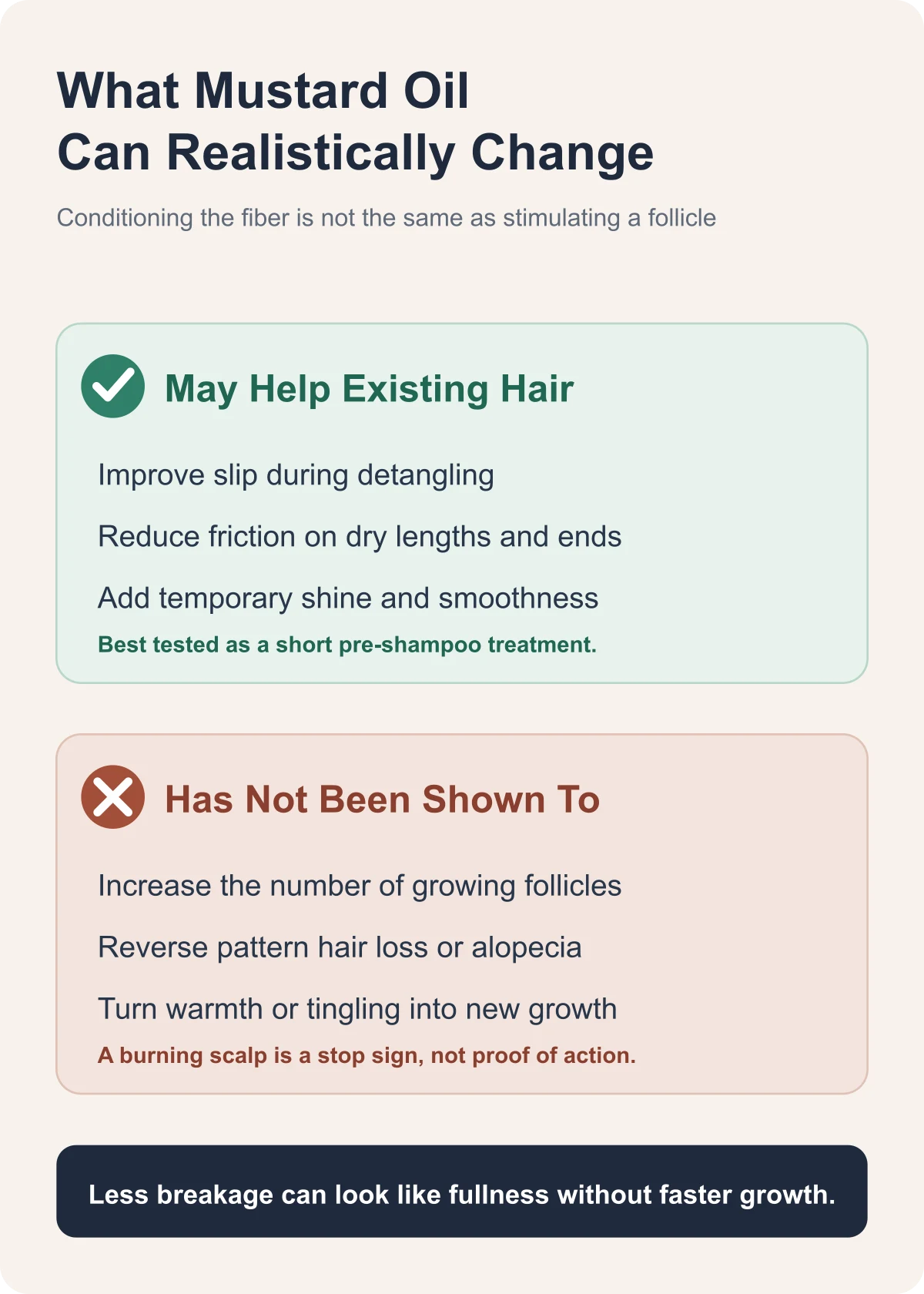
Mustard oil may temporarily improve softness, shine, lubrication, and detangling by coating the hair fiber. That can reduce mechanical friction and help fragile ends survive washing and styling. It is not a clinically proven treatment for hair growth, thinning, alopecia, dandruff, or scalp disease, and a warming sensation is not evidence that it is working.
Visible Change Is Not Always New Growth
Hair can look fuller when the lengths are smoother, shinier, and less prone to snapping. That is a useful cosmetic result, but it should be described as conditioning or breakage support, not follicle stimulation.
 Support Non-AI Creator
The Most Realistic Benefits of Mustard Oil
Softer, More Lubricated Lengths
Plant oils can form a hydrophobic film around hair fibers. That film reduces direct fiber-to-fiber friction and can make coarse, dry, curly, or weathered hair easier to comb. Mustard oil contains fatty acids that give it slip, although the amount that penetrates the shaft has not been established in the same way as coconut oil.
Less Breakage During Detangling
Breakage often happens through repeated brushing, tight styling, heat, chemical processing, and the swelling-and-drying cycle of washing. A small amount of oil before shampooing may reduce friction during handling. The benefit is most plausible on the mid-lengths and ends, where the cuticle has accumulated the most wear.
A classic hair-fiber study comparing coconut, sunflower, and mineral oils found that coconut oil reduced protein loss better than the other tested oils. Mustard oil was not tested, so the study supports the general importance of oil chemistry while also showing why benefits cannot simply be transferred from one oil to another.
Temporary Shine and Frizz Control
Oil smooths the surface and changes how light reflects from the hair. This can make strands look darker, shinier, and more aligned until the next wash. Too much oil can have the opposite effect by making fine or low-density hair look flat and separated.
A More Intentional Wash-Day Routine
For people who enjoy traditional oiling, the slow massage and pre-wash routine may make hair care feel more deliberate. That sensory benefit is valid on its own. It does not need to be upgraded into a circulation or growth claim.
Does Mustard Oil Stimulate Hair Growth?
There is no convincing clinical evidence that mustard oil applied to the scalp increases hair count, speeds the growth cycle, reverses pattern hair loss, or treats alopecia. Laboratory findings about isolated mustard compounds, antimicrobial activity, antioxidants, or blood flow do not demonstrate that a home oil treatment grows hair in people.
Massage can temporarily increase warmth and blood flow at the skin surface, but follicles are not normally waiting for a spicy ingredient to “switch them on.” If shedding, widening of the part, bald patches, scalp pain, or progressive thinning is the concern, identifying the cause matters more than choosing a stronger oil.
The review Hair Cosmetics: An Overview explains how grooming products affect the hair shaft and emphasizes that cosmetic fiber care is different from changing follicle biology. That distinction is the useful boundary here.
Why Mustard Oil Can Feel Hot or Irritating
Mustard's pungency is associated with isothiocyanates, including allyl isothiocyanate. These compounds activate sensory pathways involved in heat and irritation. A warm or prickly feeling therefore tells you that skin nerves are responding; it does not measure nourishment, circulation quality, or future hair growth.
The U.S. FDA import alert for expressed mustard oil concerns its use as food because of erucic-acid content. Products in the United States are often labeled “for external use only,” but that label is not proof of topical effectiveness or universal scalp safety. Expressed mustard oil is also different from volatile mustard essential oil; concentrated mustard essential oil should not be improvised as a scalp treatment.
 Support Non-AI Creator
A Lower-Risk Way to Try Mustard Oil
1. Start With the Hair, Not the Scalp
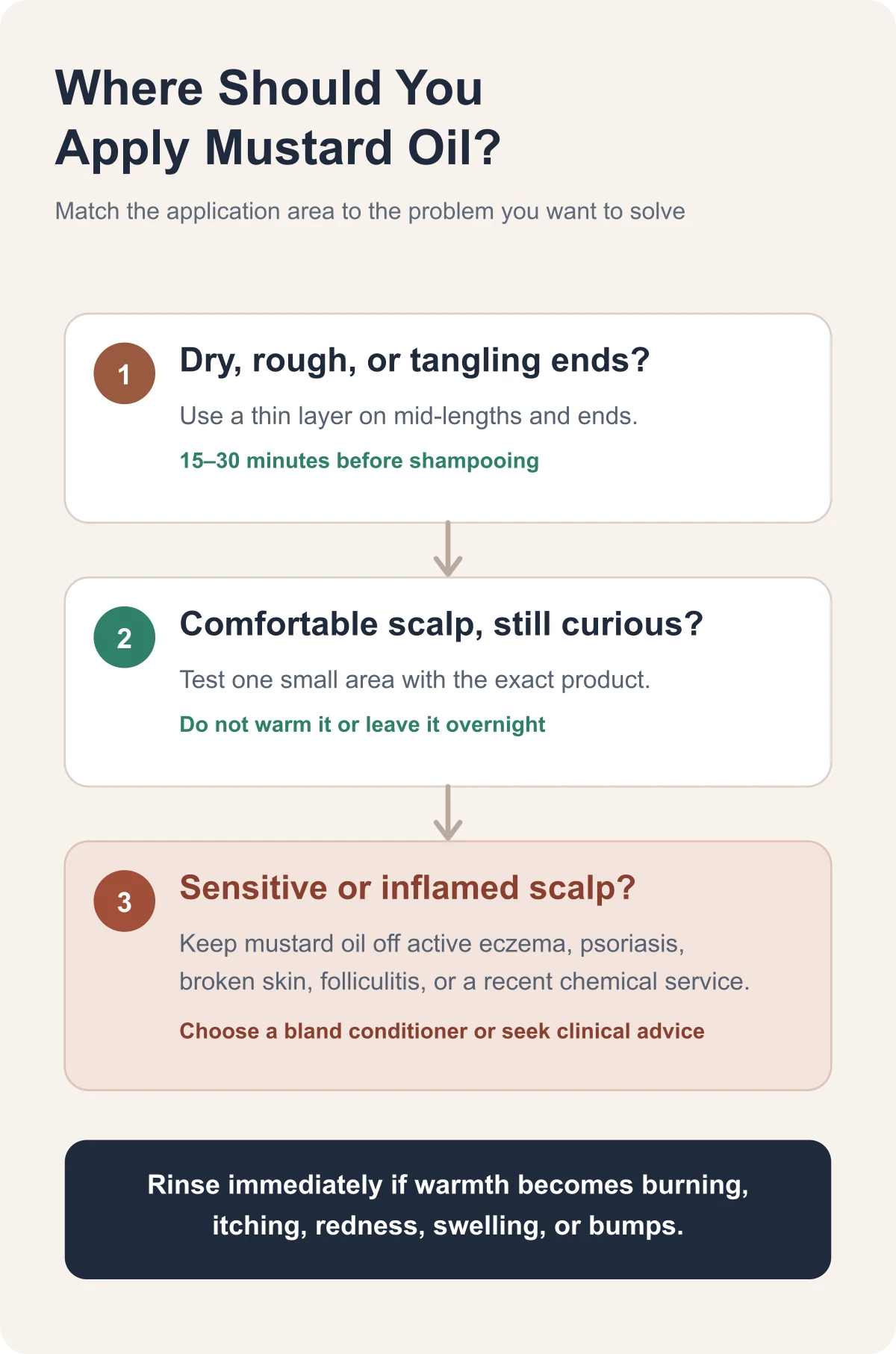
Use a teaspoon or less for medium-length hair and spread it thinly over the mid-lengths and ends. This tests slip and washability without exposing the entire scalp. Fine hair may need only a few drops.
2. Keep the First Treatment Short
Leave it on for 15 to 30 minutes before shampooing. There is no evidence that warming the oil, sleeping in it, or extending contact for hours improves growth. Longer exposure mainly makes a reaction harder to interpret and the oil harder to remove.
3. Shampoo Thoroughly but Gently
Apply shampoo to the scalp and allow the lather to move through the lengths. A second light cleanse may be needed for heavy application, but aggressive scrubbing defeats the purpose of reducing friction.
4. Judge the Result After Drying
Ask whether the hair is easier to detangle, less rough, or less frizzy without feeling coated. If it is limp, sticky, or difficult to wash, use less or choose a lighter product. A successful oil is the one that improves handling without creating scalp symptoms or wash-day damage.
5. If You Still Want to Test the Scalp
Do not apply it to broken, inflamed, recently scratched, or actively eczematous skin. Test a small area with the exact finished product and stop if warmth progresses to burning, itching, redness, swelling, or bumps. A home spot test cannot rule out allergy, so recurring reactions deserve professional evaluation.
Who Should Avoid Mustard Oil on the Scalp?
Skip scalp application if you have active dermatitis, psoriasis flare, folliculitis, open skin, unexplained tenderness, or a history of reacting to mustard or strongly fragranced botanical products. It is also a poor experiment immediately after coloring, bleaching, relaxing, tight braiding, or microneedling, when the barrier may already be stressed.
Use extra caution around children and during pregnancy, and keep the oil away from eyes and mucous membranes. If hair loss is sudden, patchy, accompanied by scaling or pain, or continues for months, an oil routine should not delay a dermatologist or primary-care assessment.
For another evidence-aware look at botanical oils, see our guide to what essential oils can and cannot do for skin.
Frequently Asked Questions
Does mustard oil make hair grow faster?
There is no convincing human evidence that topical mustard oil makes follicles grow hair faster. It may make existing hair look fuller by reducing dryness, friction, and breakage, but that is hair retention and cosmetic conditioning rather than proven stimulation of new growth.
Can I leave mustard oil in my hair overnight?
Overnight contact is unnecessary and increases exposure time if your scalp is sensitive. A short pre-shampoo treatment on the lengths is easier to assess and wash out. Stop immediately if you develop burning, persistent warmth, itching, redness, or swelling.
Should mustard oil tingle on the scalp?
Tingling is not evidence that hair growth has started. Mustard's pungent compounds can activate sensory pathways and may irritate skin. Do not chase a warming or burning sensation; rinse the oil off if discomfort develops.
Is mustard oil better than coconut oil for hair?
Not based on current evidence. Coconut oil has direct research showing reduced protein loss from hair fibers, while mustard oil does not have comparable human hair-shaft or growth evidence. Mustard oil may still work as a personal pre-wash conditioner if your hair and skin tolerate it.
The Bottom Line
Mustard oil can change how dry hair looks and handles by adding slip, shine, and temporary surface conditioning. It has not been shown to accelerate follicle growth, and its pungent compounds can irritate a sensitive scalp. Start with a small, short pre-wash treatment on the lengths, never use burning as a success signal, and seek a diagnosis for persistent or patterned hair loss.